Butoke Works in Four Principal Areas
|
Use these bookmarks to navigate this
page: |
Click here for access
to all Butoke Reports and Updates, by date.
Food Security
and Nutrition
|
|
|
Food
security has been Butoke’s first and most important area of intervention to
date. Butoke’s team of agricultural workers established their reputation in
2004, as a result of successful work in four locations. In the
summer of 2005, Butoke secured funding to pursue this work, just in time for
the Sept. 2005 planting season. As a result of this work, Butoke was able to support
185 associations of small farmers and approximately 700 farmers working
individual family plots during the months of August to October of this year.
These farmers have received basic tools and seeds (hoes, machetes), in order
to help them become reestablished, or in some cases to become established for
the first time, in agricultural activities. Click here for more information on our projects and
activities in this area. [Top] |
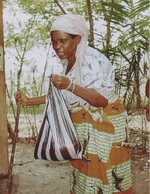
This widow
walked 60 km (40 miles) seeking seeds from Butoke . |
Health
|
|
|
Butoke’s
interventions in the health sector aim to address the needs of the most
deprived. These include dispossessed people in need of emergency medical
services, the severely malnourished,
and the disabled. Many
emergencies are turned away from hospitals for lack of ability to pay. Butoke
provides an advocate who assists hospital patients get access to needed health
care. Malnutrition is widespread, since most people eat only one meal a day,
and the food is often low in essential nutrients. Malnutrition primarily
affects children, widows, pregnant mothers, handicapped people and older
women. Butoke identifies people who are malnourished and provides both food
and nutritional counselling. Butoke’s food security and nutrition program
provides a longer-term approach. Estimates
indicate that potable water is available to only 30% of the population in
DRC. In rural areas clean water is available to only 4% of the population.
The resulting lack of access to potable water increases the risk of water
borne diseases. Butoke has responded by undertaking water, sanitation and
hygiene activities, concentrating its efforts in the territories of Luiza, Kasumba, Mueka and Demba. In a
situation where survival is often uncertain anyway, disabilities further
impair an individual’s chances. Disabled people are stigmatized because they
are considered to be “unlucky.” Existing services provide neither social
rehabilitation nor pastoral care. Butoke provides all of these. Click here for more information on our projects and
activities in this area. [Top] |
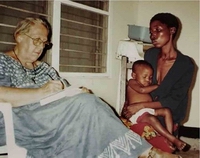
This
widowed mother and her child are both severely malnourished. |
Legal and Human
Rights
|
|
|
Butoke’s
human rights program focuses on three of the most marginalized groups in
society in the region: prisoners, widows
and orphans. Butoke’s
lawyers have established that one third of the prisoners in Kananga prison
have not been accused of any crime. Since December 2004, Butoke has secured
the release of 15 inmates of the 150 incarcerated in Kananga prison. Butoke
also provides food for prisoners. The prison does not provide food, or other
essentials, so prisoners are dependent of their families to supply them. However, two thirds come from other
provinces and so have no local support network. Many die from malnutrition and disease. Death
rates among men are high, due to war, accidents, violence, alcohol
and drug abuse. As a result, 30% of adult women are widows. Widows are
regarded as “witches,” blamed for the death of their husbands and so disinherited.
Many become prostitutes. Butoke’s
food security and nutrition program (see above) helps these women to secure a
sustainable way of feeding themselves and their families. Butoke
offers support in other ways as well. In 2005, it initiated a legal aid
project focusing on the legal rights of widows. It also undertook an
awareness-raising program at the parish level on the rights of women and
children, with emphasis on widows and orphans. One of
the results of this work has been that numerous orphans identified as
“sorcerers” were referred to Butoke. Butoke accommodated these orphans in 2006 by
opening an orphanage, for 40-50 children, of whom more than 30 are boys. [Top] |
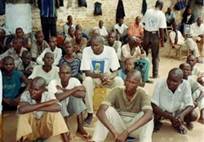
Prisoners
in courtyard. Butoke’s lawyers have established that one third of prisoners
have not been accused of any crime. Since Dec. 2004, Butoke’s lawyers have
secured the release of 15 of the 150 inmates in Kananga prison. |
Education
|
|
|
Butoke
has been working in the education sector since 2004. We see education as a
tool not only to ensure the socio-economic status of individuals and their
families, but as well, to ensure the development of the community. However,
the gap between the ideal and reality is particularly huge in Congo, where
students rarely achieve the basic competencies that they need in reading,
writing and arithmetic, nor what they need in terms of general culture, and
development of basic social values as required under a human development
approach. In 2008-2009, Butoke organised special
retraining of 40 teachers and 20 school directors on appropriate teaching
methods for French, mathematics and peace and reconciliation in the first two
primary grades. We
provide direct support to the most vulnerable children. At the end of 2014,
we were supporting 98 vulnerable students at the primary school level, and 47
students at the secondary school level and above. Butoke covers school fees
for these children and provides basic school materials such as notebooks and
pens. Without such support, the most deprived would not have any way of
pursuing an education. As of
2015, Butoke has taken on a project to set up its own school, based on modern
pedagogical principles, with the objective of offering higher quality
educational opportunities to children in the community. To learn more about
this project, see the proposal document (available only in French at this
time), titled, “Projet d’école primaire de Butoke et la place de l’éducation dans sa stratégie de développement humain.” See also the modest collection
of that we have put together to celebrate the burning of the first bricks for
constructing the school. [Top] |
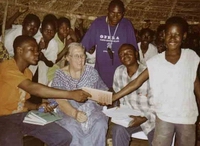
Handing
out notebooks to sponsored students. |